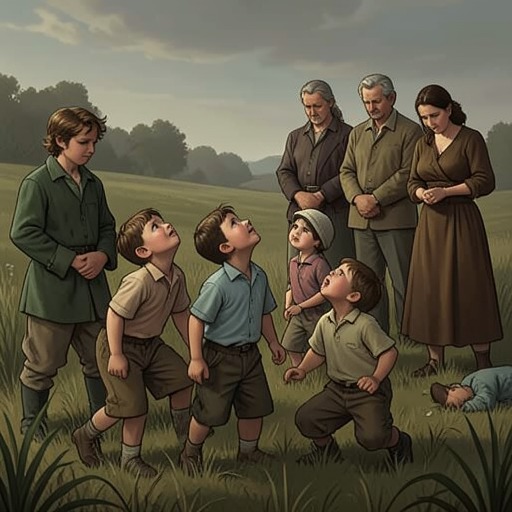
The 1933 TR wildfire and Carla Dean’s death
Bag of BonesThe 1933 TR wildfire and Carla Dean’s death expose how a fast-moving natural disaster becomes the setting for a private act of violence—and how that act survives in public memory as a story of rescue and loss. A newspaper account, recovered among Jo’s research papers, records the fire’s approach to Halo Bay; in a subsequent vision, the history becomes immediate and undeniable as Fred Dean carries his daughter into the lake and holds her beneath the water.
The Fire Reaches Halo Bay
The wildfire broke out in the eastern part of the TR while Fred Dean was fighting it with two hundred other men. The wind shifted, turning the north end of the lake, previously considered safe, into a new target. Halo Bay—then a named community with a general store and numerous fishing and hunting camps—held Fred’s wife, Hilda, their three-year-old twins William and Carla, and other local families. The men were away fighting the fire, leaving those at the settlement to face the changing danger themselves.
The flames advanced “like marching explosions,” jumping the only firebreak the firefighters had made in that direction. The woods had gone without rain since late April, and the wind drove the fire toward the far end of the lake. Women tried to load children and camp possessions into cars, but the rush clogged the sole road out. When an old car or truck stalled, vehicles behind it could neither pass nor turn around; as the fire closed in, those who had waited found their way blocked.
Volunteer firefighters arrived in time to rescue the stranded group, but the evacuation had already separated Carla from her family. Hilda had put both twins in the back seat, holding hands as they usually did. While Hilda placed last items in the trunk, Carla apparently went back to the cottage for a toy or doll. Hilda drove away without checking that both children were still in the car. When Fred reached her, William was asleep on the floor in the back, but Carla was gone. She could have remained at the cottage or started walking up the road; either way, the advancing fire was likely to reach her.
Fred and Carla at the Lake
With the road too narrow to turn around and too congested to drive back through, Fred ran toward the smoke and the orange firelight. The narrative later reconstructs what followed: he found Carla amid the burning cabins and brought her down the slope toward the water. The domestic details of the scene—the laundry burning on lines behind a cabin, the ember that struck Carla’s neck, and her cry of pain—place the child’s terror inside a landscape being consumed around her.
Carla told her father she could not swim. Fred answered that she would not have to, a reassurance whose meaning the vision makes horrifyingly clear: he was not taking her to safety on the opposite shore. He carried her farther into the water, among loons fleeing across the lake, as fire formed a burning crescent along the eastern and northern edges. The scene frames his action as a false rescue. He presents the lake as refuge from the flames, but uses it to drown the child.
Fred kissed Carla to stop her screams and held her under. Even as she struggled, he looked toward the still-blue western sky and told himself that her death was an accident: that the water was the only place left to take her, that she panicked, that he lost his hold. The account exposes the gap between this self-exculpating story and what he does. He does not simply fail to save Carla from the fire; he deliberately keeps her submerged, then recasts the killing to himself as an unavoidable accident.
Records, Reticence, and the Reappearing Past
The event enters the novel through a newspaper clipping dated July 19, 1933, with the headline “VETERAN GUIDE, CARETAKER, CANNOT SAVE DAUGHTER.” The clipping reports the changed wind, the jammed escape road, Fred’s discovery that Carla was missing, and his run back toward the fire. Its account presents him as a heroic father racing to find his child; the vision supplies the concealed ending that the newspaper does not report. The difference between the headline’s rescue narrative and the drowning scene makes the archive both a source of historical fact and evidence of how much the public record leaves unsaid.
The clipping is part of Jo’s cache of photocopied local press stories, which Michael Noonan discovers beneath Jo’s studio. He recognizes that she gathered and hid the material during her July 1994 visit to Sara Laughs, and that she had left it for him to find. The oldest clipping in the collection dates to 1865 and concerns Jared Devore; the sequence helps Michael connect the township’s generations and its suppressed history. Jo’s investigation had begun as research for an article, gathering stories from residents and drawing out old letters and diaries. The fire story therefore reaches Michael not through an official local history but through the private archive she assembled.
That distinction matters in a community where, as the later account of Jo’s notes makes clear, histories of the Red-Tops’ departure were absent from town histories. Their treatment in contemporary clippings is marked by genial contempt and racist descriptions, even when the pieces purport to be favorable reviews. The town’s printed record can preserve dates and incidents while distorting the people it describes or omitting the violence behind what happened. In the wildfire episode, the newspaper records a father unable to save his daughter; the vision reveals the killing that this formulation conceals.
Vision and Meaning
Michael’s encounter with the fire is not a detached reading of an old article. As he studies the clipping beneath the studio, the smell of burning intensifies and he feels the iron taste of water in his mouth, as if drowning. He sees the lake, ash, smoke, and approaching flames, then enters the scene as a ghostly witness, unable to change what happened. When Carla reaches toward him for help, his arms pass through her. The vision’s helplessness gives the old event a present-tense force without undoing its outcome.
The episode joins two threats—fire and water—through the language of rescue. Fred claims to be saving Carla from the flames, but his supposed refuge becomes the means of her death. Michael, in turn, reaches for the child but cannot touch her; his powerless intervention contrasts with Fred’s physical control. The narrative makes that contrast the emotional hinge of the vision: the child’s repeated need for rescue remains unanswered both in the remembered past and in Michael’s impossible attempt to intervene.
The wildfire also belongs to the novel’s wider pattern of local history preserved unevenly through clippings, oral accounts, and hidden documents. Its immediate destruction is dramatic, but its longer afterlife lies in what the records name, what they cannot say, and what later generations must reconstruct. The reported loss of a child becomes, through the vision, a concealed act of violence; the recovered archive turns a disaster long framed as a failure of rescue into evidence of Fred’s responsibility for Carla’s death.